From the Fjords to America: My Erickson Family History

Preserving my family’s Norwegian heritage

Verified through documented research, my mother’s Erickson ancestry traces back several centuries in the Stavanger region of Rogaland County, located in Southwestern Norway.

2018 visit to Rogaland County, Norway

Ragnhild is an Old Norse name: ragn (advice) + hildr (battle) meaning “advisor in battle”. Ragnhild Iversdatter (my mother’s 3rd great grandmother) was born in 1796 on the Helland farm in Strand, Rogaland, Norway. She was the youngest of six children born to Iver Torsteinson Lyse and Marthe Eriksdatter Underberge. Ragnhild’s parents shared deep rooted ancestry (est. 1400’s) in the village of Lysebotn, located at the head of the Lysefjord.

Lysebotn, Rogaland, Norway (photo courtesy of Band of Climbers)

In 1820, Ragnhild married Tollef Torgerson and settled in a flat terrain section on the Helland farm known as Hellandsmoen. Between 1820 to 1825, they had four children; Martha, Helga, (a second Helga) and Iver. In the summer of 1826, tragedy happened when Tollef drowned while fishing at sea. A few years pass by before Ragnhild married her second husband; Erik Olson, on April 9th, 1829 at Strand Church.

Rogaland County, Norway

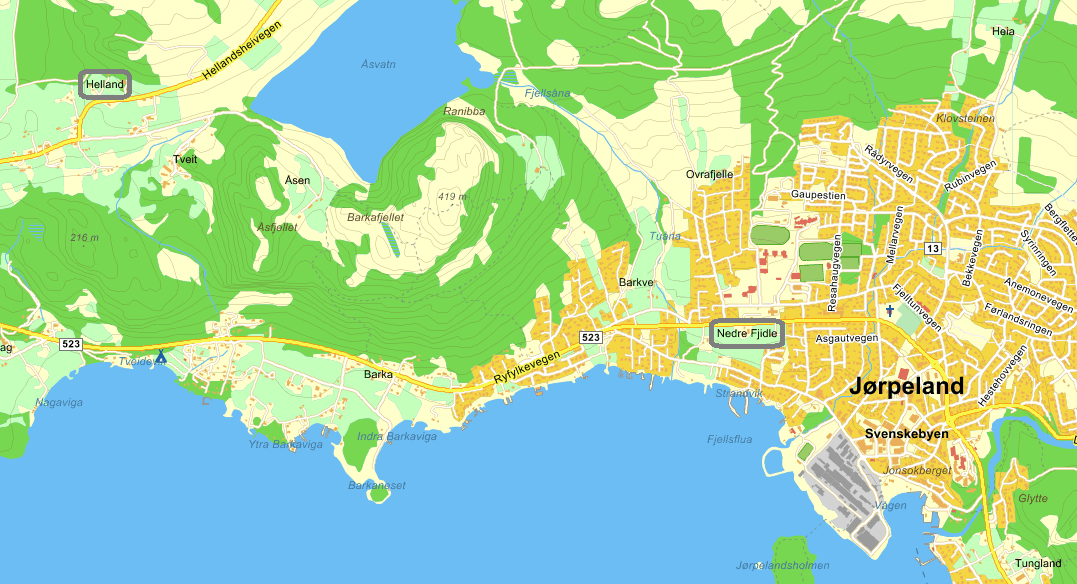
Erik Olson (my mother’s 3rd great grandfather) was born in May of 1800 in a section of the Nedre Fjelde farm known as Grøtnæs. Nedre Fjelde is one mile southeast of the Helland farm, located in the town of Jørpeland. Erik was the youngest of three children born to Ole Erikson Barkved and his fourth wife, Marthe Olsdatter Birkeland.
(click-view all images)

In Norwegian tradition, it is customary to name the firstborn son in a second marriage after the deceased husband (and vice versa for a deceased wife) from the first marriage. On August 2nd, 1829, Erik and Ragnhild had their firstborn son and named him Tollef (in homage to Ragnhild’s late husband). Between 1831 to 1838, they had four children; Jonas, Elen, Marthe and Berthe.
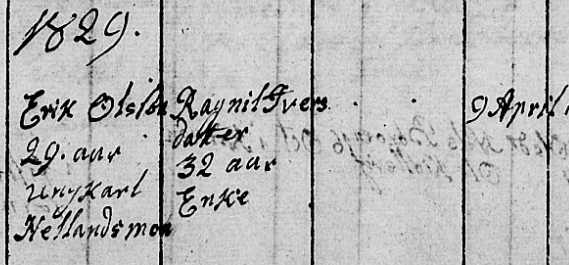
Erik Olson (age 29) married Ragnhild Iversdatter (age 32) in 1829 at Strand Church

Tollef Erikson married Ingeborg Svendsdatter on March 24th, 1854 at Strand Church. Ingeborg was born on February 14th, 1824 on the Nedre Fjelde farm. She was the middle child of three children born to Svend Endreson Erevik and his second wife, Berthe Knudsdatter Nedre Fjelde.

Tollef Erikson (age 24) married Ingeborg Svendsdatter (age 29) in 1854 at Strand Church

Less than two weeks after their marriage, Tollef and Ingeborg (along with Tollef’s younger sister, Marthe) traveled a short distance by boat across the Idsefjord to the port of Stavanger; Where on April 4th, 1854, they immigrated to America.

LaSalle County, Illinois

Tollef’s older half-brother; Iver, was the first in the family to immigrate to America, in 1848. He went to work and lived in one of the earliest Norwegian settlements in America; LaSalle County, Illinois. Iver sent letters back to Norway, describing his livelihood in America. During the summer harvest, he earned 50 cents a day swinging the cradle and scythe throughout the rich crop fields while in the fall, he traveled down the Mississippi River and cut cordwood for 50 cents a cord, including room and board.

Tollef, Ingeborg and Marthe arrived at Ellis Island in late Spring of 1854. Following Iver’s path, their destination was La Salle County, Ill. During the 1850’s, the journey from New York to Chicago took one month, which was accomplished by traversing the riverway with boats drawn by horses on land.

In 1855, Tollef and Ingeborg had their second child; a daughter named Rachel Marie Erickson. Their firstborn son; Erick, died during infancy.

Fillmore County, Minnesota

The first Norwegian settlement in the territory of Minnesota was established in Fillmore County and therefore, this county is mentioned in connection with the first settlers. The first Norwegian American child born in Minnesota was in 1852, also in Fillmore County. Prospectors from LaSalle County, Illinois described the climate and terrain as similar to their homeland in Norway. In 1853, a small influx of Norwegian immigrants came to settle in Fillmore Co. Some of the early pioneer families came by way of LaSalle County, including Christian Christopherson and his wife, Helga (Tollef’s older half-sister).

Cedar Valley Resort in Fillmore County, MN

In 1856, Tollef moved his family to Fillmore County, MN. He acquired 60 acres of farmland in the village of Highland in Holt Township, and named his farm: Vindhaug [Windy Hill]. Iver Thompson (Tollef’s older half-brother) moved here as well and acquired 120 acres of farmland, just two tracts to the north of the Erickson’s. Tollef and Ingeborg’s third child; Betsey, was born on May 27th, 1858 (just two weeks after the state of Minnesota joined the Union). By 1860, all of Tollef’s siblings, including his parents, had immigrated to America and would eventually settle in Fillmore County.

Erik Olson (Tollef’s father) was buried at North Highland Cemetery in 1874. Transcription at the bottom reads: Fred med din støv. Velsigne være din minde – Peace with your remains (dust). Blessed be your memory

Between 1860 to 1868, Tollef and his wife would have four more children; Elen Serine, Elias, Sven and Ellen Sorine (the latter named in homage of Elen Serine, who died in 1863).

1870 census – Holt, Fillmore, MN. Thomas [Tollef] and Isabel [Ingeborg] Erickson with their children

The neighbors to the west of the Erickson’s were Osmund and Barbro Johnson. Osmund Johnson was a local Civil War hero who served in the Wisconsin Scandinavian Regiment and was once a prisoner of war who was fortunate to survive an eight month sentence at the infamous Andersonville Prison.

1870 plat of Holt Township. Tollef Erickson’s property (highlighted) with neighbors; Osmund Johnson and Tollef’s older half-brother, Iver Thompson [Tollefson]

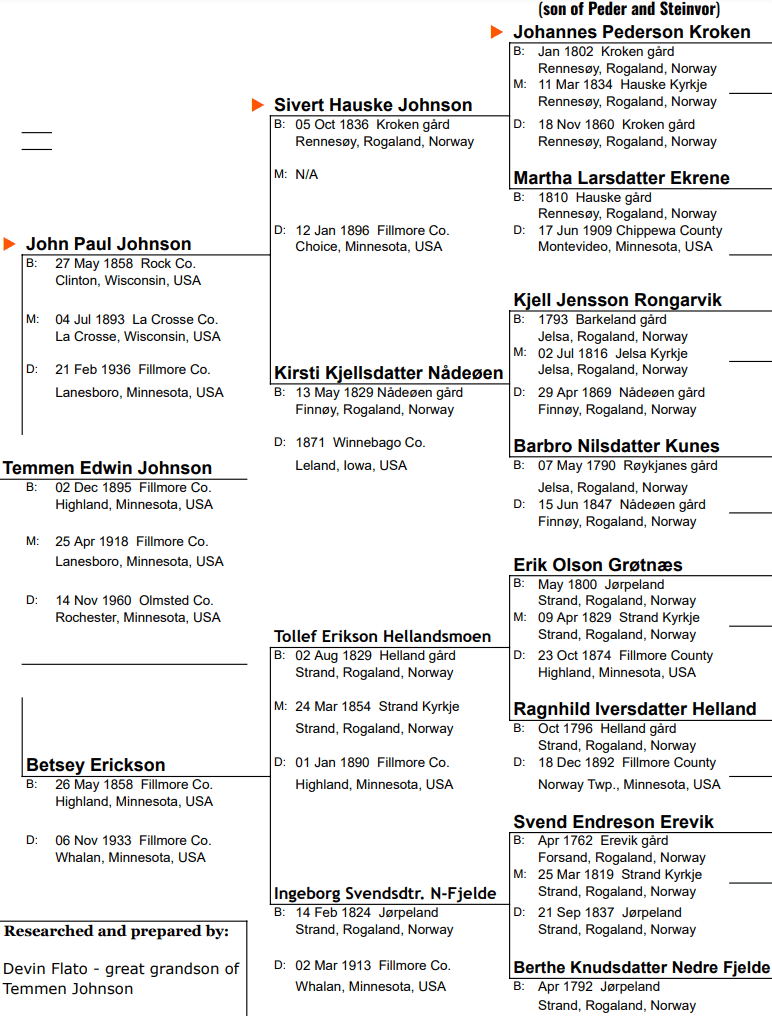
On July 4th, 1893, Osmund’s daughter; Clara, and his nephew, John Paul Johnson, took part in a double wedding in La Crosse, Wisconsin. John married his aunt & uncle’s next door neighbor, Betsey Erickson. John’s mother; Kirsti Reierson, was the younger sister of Barbro Johnson. The Erickson’s, Johnson’s and Reierson’s were not only family, but close friends and pioneer members of Elstad: The second oldest Norwegian Lutheran congregation in Minnesota.

1893 Double wedding – On the left: BRIDE Clara Johnson and her husband, Ervin Keifer. In the middle: WITNESSES Ellen (Erickson) Vaaler and her brother, Elias Erickson. On the right: BRIDE Betsey Erickson and her husband, John P. Johnson. *Note- Clara Johnson was John P. Johnson’s first cousin, and the witnesses were Betsey Erickson’s siblings.

John and Betsey (Erickson) Johnson were my mother’s great grandparents.

Tollef Erickson died from heart disease on January 1st, 1890 in Highland. He was 60 years of age. His wife; Ingeborg, passed away at their daughter (Ellen)’s house in nearby Whalan on March 2nd, 1913. They were buried at Elstad Cemetery. 

sources;   Elstad Lutheran Church records, the Digitalarkivet and family obituaries

Genetic Mapping:  Finding the Earliest Genetic Ancestor

A comprehensive autosomal DNA study

“A DNA segment is a time capsule, containing a genetic puzzle.”

Code Break 23

DNA segment on Chromosome 14 • Measuring 23 centimorgans in total length, it is a fraction of the genome that I inherited from my maternal great grandfather; Temmen Johnson (1895 – 1960). In accordance with genetic genealogy, a segment of this size is inherently much older than larger DNA segments, and therefore regarded as impractical for analysis. On the contrary, there is power in numbers, as I managed to find fifteen DNA matches to form a Triangulation Group within the mentioned segment coordinates.

segment coordinates: [82966993 – 97529421]  23cM

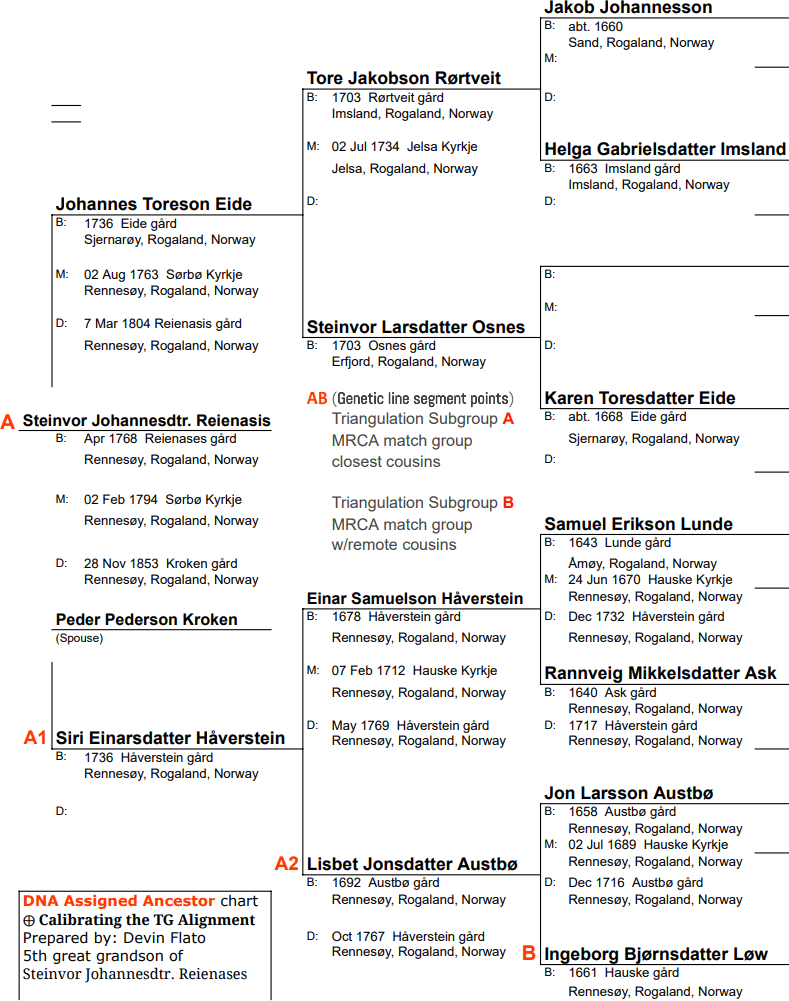
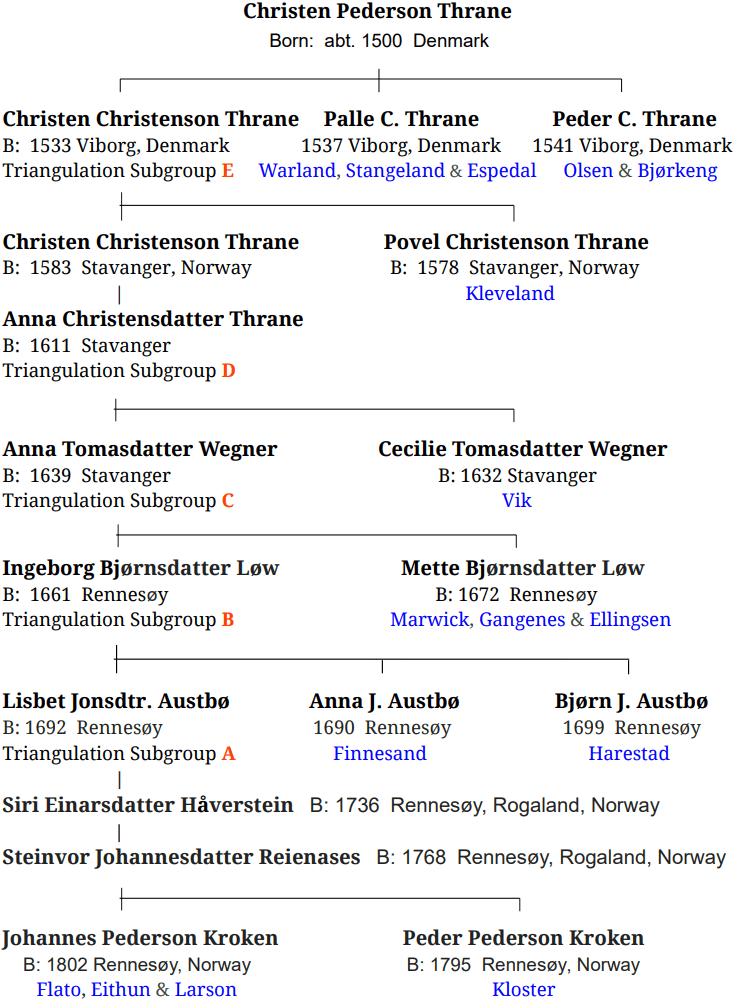
My closest known cousins matching me within these segment coordinates are Eithun, Larson and Kloster. We share common ancestry through my 5th great grandparents; Peder Pederson Kroken (1768 – 1845) and Steinvor Johannesdatter Reienasis (1768 – 1853) from Rennesøy, Rogaland, Norway.

Triangulation Subgroup A

(Click-view all charts and images to enhance mobile version)

My objective for this Autosomal DNA study is to analyze and interpret the path of shared DNA segment inheritance from the earliest known common ancestor.

2018 visit to Western Norway

Introduction

The Norwegian Bygdebøker [farm books] are the primary source of family history and genealogy for researchers learning about ancestry in Norway.

Page from the Rennesøy Bygdebok – my 5th great grandfather [5] and 4th great grandfather [c]

The church and census records in Rogaland County date back to the 1600’s, while the court records date back much further. These genealogical records (including the bygdebøker) make it possible to trace Rogaland ancestry back to the 1600’s and earlier. Of the fifteen DNA matches in this study, thirteen of them share deep rooted ancestry in Rogaland.

Rogaland County in Southwestern Norway

Shared Ancestry in the Triangulation Group

After a period of extensive research and collaboration with TG [Triangulation Group] matches, I found a total of three separate common ancestral couples from the 1600’s, shared within my Rogaland County match group. Only one of the mentioned couples; however, is the genetic placeholder in the Triangulation Group.

Calibrating the TG Alignment

The lineal pathway of a shared DNA segment, must coincide with the segmentary lineage within a Triangulation Group. Undertaking this genealogical task requires a process of elimination among multiple common ancestors, in order to balance and interpret the alignment of shared Genetic Ancestors.

The following ancestral charts include all of the TG matches, sorted and arranged in an incremental system of individual scales. A format that I refer to as Segmentary Lineage Scales.

Shared ancestral couple #1

Shared ancestral couple #2

Process of Elimination

While the charts above identify common ancestry with several of my TG matches, I did not find relation of additional TG matches within the ancestry of the mentioned couples. Of the three ancestral couples shared within my Rogaland County match group, only one remains as a placeholder in the Triangulation Group (see next chart).

Shared ancestral couple #3

Jon Austbø and his wife; Ingeborg, were the great grandparents of Steinvor Johannesdatter Reienasis (mentioned in connection with Triangulation Subgroup A). This observation links a subgroup consisting of my closest cousins, to an earlier MRCA [Most Recent Common Ancestor] match group consisting of remote cousins. Thus, forming a new triangulated subgroup.

Triangulation Subgroup B

Tipping the Scales

Concepts of geometry support the methods that led to the convergence of the new subgroup (B). The framework of this genetic alignment calibration, using line segment points, scales and patterns, led me on a refined path of new discoveries, as demonstrated in the following charts.

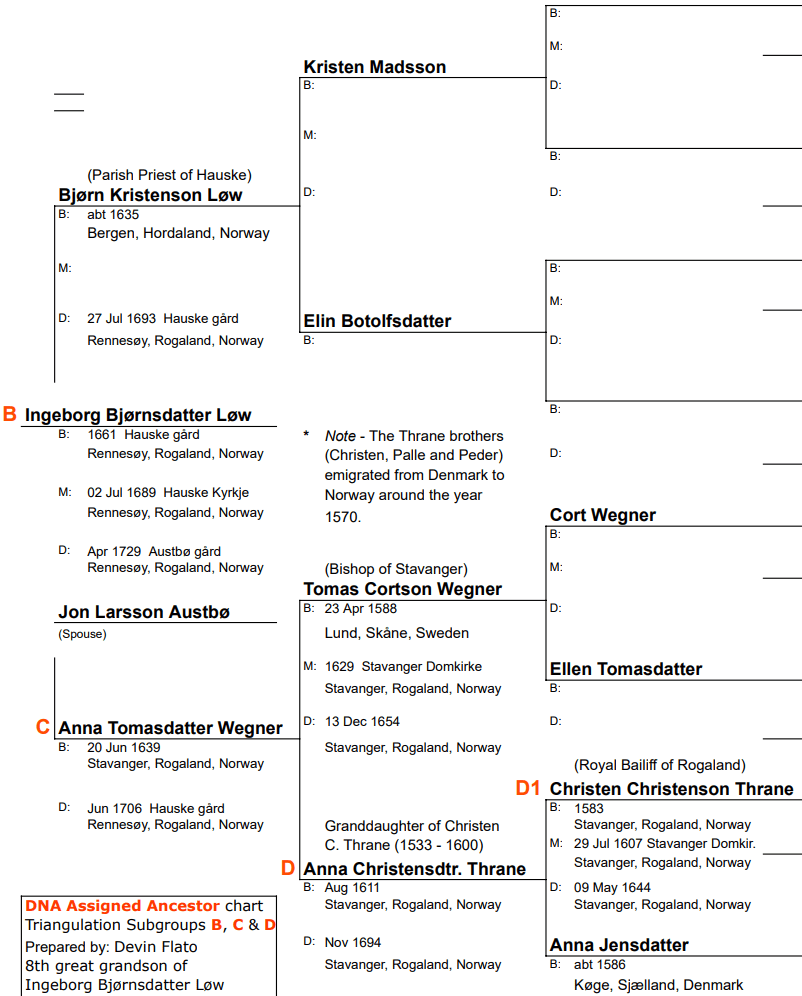
Ingeborg Bjørnsdatter Løw – MRCA of Triangulation Subgroup B, was the daughter of Bjørn Løw and Anna Wegner.

Triangulation Subgroup C

Anna Tomasdtr. Wegner – MRCA of Triangulation Subgroup C, was the daughter of Tomas Wegner and Anna Thrane.

Triangulation Subgroup D

The Power in Numbers

The majority of my TG matches (nine of fifteen) share common ancestry through Tomas Cortson Wegner and his wife, Anna Christensdatter Thrane. This cumulative pathway was revealed through the ascending order of triangulated subgroups. – A strategy that I developed, which coincides with the ascending alignment of my DNA Assigned Ancestors.

17th Century epitaph painting in Stavanger Domkirke – Norway’s oldest Cathedral. Anna Christensdatter Thrane [standing center] was my mother’s 9th great grandmother. Anna’s husband, Tomas Cortson Wegner (not present in the painting) was the Bishop of Stavanger until his death in 1654.

Anna Christensdtr. Thrane – MRCA of Triangulation Subgroup D, was the granddaughter of Christen Thrane & Karen Povelsdatter.

Triangulation Subgroup E

Pattern Recognition

While searching for DNA matches with the ancestral surname; Thrane at MyHeritage, I found Olsen and Bjørkeng, and to my surprise, they matched me on Chromosome 14. Olsen and Bjørkeng (from the unrelated column) are distant cousins to each other, with deep ancestral roots in Northern Norway. They do; however, share one distant ancestor from Southwestern Norway – Peder Christenson Thrane (1541 – 1622) from Stavanger. Coincidentally; Stangeland, Warland and Espedal (also from the unrelated column) descend from Peder’s brother; Palle Christenson Thrane (1537 – 1584). Peder was the half-brother of Palle and Christen Christenson Thrane (1533 – 1600) – my Direct Ancestor, and of all other matches within the Triangulation Group.

All fifteen of my DNA matches, sharing IBD (Identical By Descent) segments on Chromosome 14  

My Conclusion

Christen Pederson Thrane, born circa 1500 in Denmark, and father of Christen, Palle and Peder Thrane (mentioned above), is the Apical Genetic Ancestor of the DNA segment that I inherited on Chromosome 14, including for all of my DNA matches mentioned in this project.

Segmentary lineage chart – ascending to the Apical Genetic Ancestor of the Triangulation Group

Confirmed Relationship of My DNA Matches

(Last) NameShared segment cM’s Genetic relation
Eithun15.93rd cousin, 1R
Larson8.35th cousin
Kloster22.76th cousin
Harestad19.69th cousin
Finnesand7.48th cousin, 1R
Marwick22.79th cousin
Gangenes7.77th cousin, 3R
Ellingsen11.09th cousin, 2R
Vik8.68th cousin, 3R
Kleveland10.413th cousin
Stangeland21.612th cousin, 2R
Warland17.813th cousin, 1R
Espedal12.914th cousin, 2R
Olsen15.314th cousin
Bjørkeng9.512th cousin, 2R

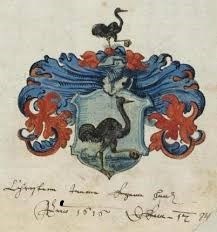
Thrane Family Crest

“The crane holds a stone (a symbol of vigilance). If the crane drops the stone, the stone splashes into the water – alarming the area”.  Suggesting that the family is closely guarded.

Disclosure

A DNA discovery of this magnitude has substantial hurdles and therefore, I must address the complexities in my conclusion of this study.

  • Coefficient of Relationship. Whether distant or remote, endogamy is intertwined in our ancestry. Even a random cousin marriage in recent or distant generations will undoubtedly complicate the outcome in Autosomal DNA research. However, as substantiated in this study, there is no evidence of pedigree collapse within the direct inheritance pathway of my DNA Assigned Ancestors. Consequently, this keeps the coefficient of relationship accurate and unaffected by inflated DNA sharing.
  • Segment Phasing. While sorting through shared matches with my siblings and TG matches, I was able to identify my false positive matches on Chromosome 14, and exclude them from my research.
  • Tree Completeness. Traditional genealogy is the weakest link in the practice of genetic genealogy. With that being said, I began to hit the occasional brick walls in my research of DNA ‘match trees’ at about eight generations. However, most of the branches in all of the Norse related trees traced back much further. In part, due to the broad relation and documentation of prestigious heritage throughout the Stavanger Region.

My conclusion in this DNA study was formed upon two (pandemic era) years of extensive research, including: Pedigree triangulation, segment data mapping, cross referencing records, collaboration with DNA matches, building mirror trees with integrity, and utilizing every genealogy tool to the best of my ability.

“Only those who attempt the absurd can achieve the impossible.”

Albert Einstein

Genetic Profiling: Y-DNA Edition

How I used Y-DNA analysis in tandem with autosomal DNA to solve a distant family mystery.

1918 – John and Betsey Johnson (on the right) were my mother’s great grandparents

John Paul Johnson (my mother’s great grandfather) was born out of wedlock and was by far, the most challenging ancestor to research. Nothing was known about his parents.. Who were they? Where did they come from? In 2014, the floodgates opened when I took a DNA test.

My origins at Family Tree DNA

In December of 2013, I, Devin Flato, took the autosomal DNA test with Family Tree DNA. On January 14th, 2014, my results appeared in the FTDNA database. The next day, someone contacted me with the following message…

Hi, You match me, my sister Victoria, and my mother Helen, on a DNA segment which is associated with cousins who descend from common ancestors; Lars Bjørnson Ekrene (1780 – 1822) and Marta Larsdatter Nordbø (1786 – 1876). They came from Southwest Norway- Rennesøy, Rogaland. Unfortunately, I have limited information about them, to the disgust of my cousins on my mom’s side, but if you are interested I could probably ask someone who might know more.

Risa farm in Rennesøy, Norway

The message was from a predicted ‘second to fourth cousin’ named Julianne. Her revelation was intriguing yet, baffling to me at the same time. My mother’s paternal grandmother’s ancestry was from Sogn og Fjordane County, which is far north of Rogaland and out of the realm of possibility. Without a doubt, the relation would certainly come from my mother’s paternal grandfather; Temmen Johnson (1895 – 1960). Temmen’s maternal side of the family (the Erickson’s) have deep roots in Rogaland. The dilemma with this query is that the names and place that she mentioned are not found in my Rogaland ancestry, which is well documented through the 1700’s and beyond. In Julianne’s second message, she wrote…

Dear Devin, both my mom and I have also tested at 23andMe, where we both match a cousin whose most obvious connection to us is through common descent from that couple [Lars Bjørnson and Marta Larsdatter]. I descend through their daughter Marta and through her daughter Stine Johnson who married John Ludvig Larson. My cousin descends through their son, Rasmus Larson Hauske (1815-1900), Rasmus Hauske (1860-1925) and Mabel Hauske. She shares another segment match with us on Chromosome 2 and matches us on the same segment we match with you. I know we are looking at the same half of the chromosome pair because both of you match my mother.

Chromosome browser at Family Tree DNA

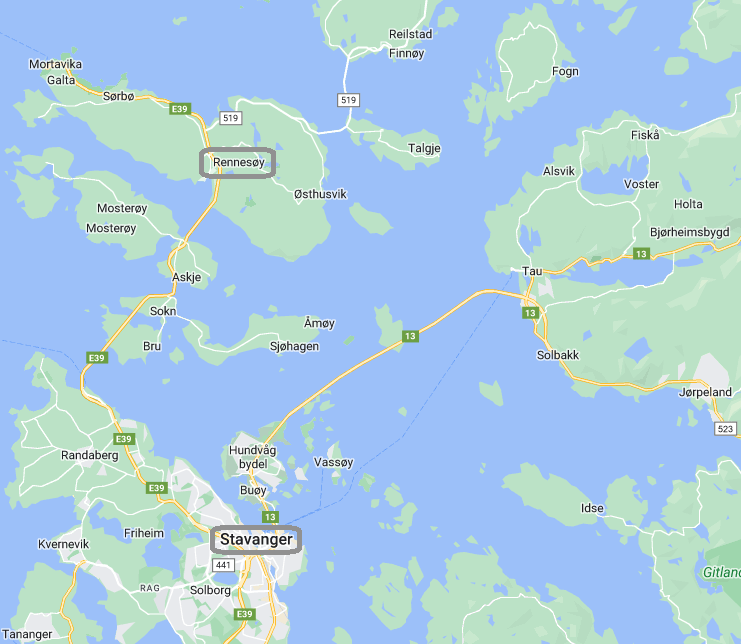
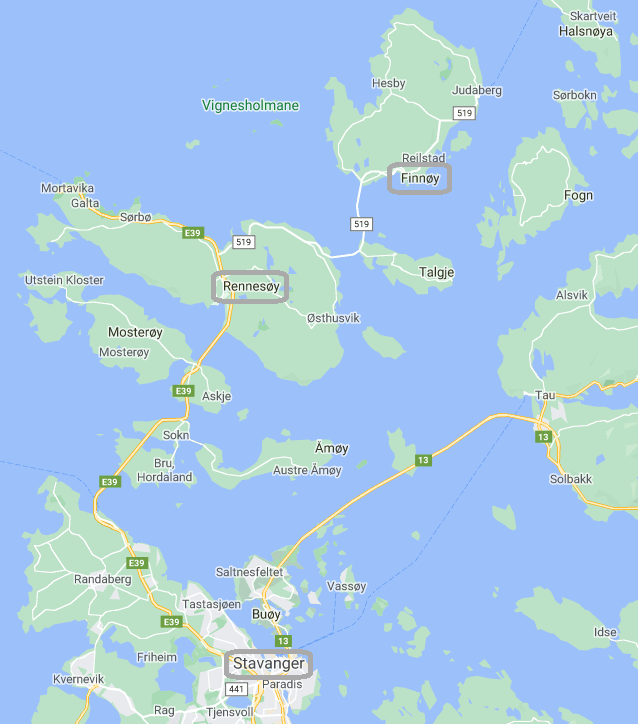
After exchanging a few emails, Julianne sent me an invitation to view her family tree at Ancestry.com. While searching for clues in her family tree, I noticed a mutual place of interest. Her Norwegian ancestors settled in Fillmore County, Minnesota (the same county where my Norwegian ancestors settled). Another interesting clue is that the island of Rennesøy is less than two nautical miles southwest of the island of Finnøy, where Kirsti Kjellsdatter (John P. Johnson’s mother) was born and raised. Then it dawned on me, could Julianne’s family be the missing link in John P. Johnson’s paternal ancestry?

Rogaland County, Norway

John Paul Johnson was born in 1858 in Wisconsin. Nothing was known about his parentage until in 2011, when I randomly found John and his mother in an 1870 Iowa census record; However, the identity of John’s biological father remained a mystery.

1870 Forest City, IA. John Johnson (age 12) with his mother (Christy) and step-father; Paul Ryerson and half-siblings

Julianne’s great great grandmother was Stina Marie Johannesdatter (1843 – 1909). Stine, along with her brother (Peder) and her mother (Martha) immigrated to America in 1862. Stina had two older brothers; Lars and Sivert, who immigrated in 1853 and 1854. Upon arrival in America, all of the brothers changed their patronymic name of Johannesson to the surname of Johnson. Could one of the older brother’s be the biological father of John P. Johnson?

While searching for more answers, I found a descendant and family historian of the Johnson/Rennesøy family named Rachel Gibson. Like Julianne, Rachel is also a descendant of Stina Marie Johnson and has been a tremendous help with her own research and knowledge of the family. We learned that Stine’s eldest brother; Lars, settled in Minnesota in 1855, long before the birth of John Johnson in the State of Wisconsin. Suddenly, the scope of possibility was narrowed down to one brother; Sivert Johnson.

In the following months after taking the DNA test, four more descendants of the Johnson/Rennesøy family tested at Family Tree DNA and the results confirm that I am closely related to all of them. One of the testers; Phillip Johnson (great grandson of Sivert Johnson) took the Y-DNA test, which traces the paternal “father to father” line exclusively. My mother’s first cousin; Larry Johnson, agreed to take the Y-DNA test as well. In July of 2014, the results were in, and confirmed that Larry and Phillip Johnson are Y-DNA cousins! Now we have proof that our Johnson lineage descends from the Johnson family of Rennesøy!

Y-DNA genetic distance report at Family Tree DNA

It has been concluded that Sivert H. Johnson (1836 – 1896) was the biological father of John P. Johnson. The extent of Sivert and Kirsti’s relationship continues to be a mystery. I suspect that Sivert remained close to Kirsti until the time of John’s birth for one reason in theory.. If Sivert and Kirsti parted ways shortly after conception, then Kirsti would have likely named her son: Kjell (after her father). Instead, she named her son: John, in homage to Sivert’s father (Johannes). This pattern is traditional in the Norwegian naming system.

Sivert H. Johnson, circa 1870 – Biological father of John P. Johnson

We may never learn the reason as to why John P. Johnson’s biological father was never mentioned in family lore. Regardless of the matter, it is truly fascinating that with genetic testing and conventional genealogy, our 156 year old family secret was officially solved!

“There are no secrets that time does not reveal.”

Jean Racine