
“A DNA segment is a time capsule, containing a genetic puzzle.”
Code Break 23
DNA segment on Chromosome 14 • Measuring 23 centimorgans in total length, it is a fraction of the genome that I inherited from my maternal great grandfather; Temmen Johnson (1895 – 1960). In accordance with genetic genealogy, a segment of this size is inherently much older than larger DNA segments, and therefore regarded as impractical for analysis. On the contrary, there is power in numbers, as I managed to find fifteen DNA matches to form a Triangulation Group within the mentioned segment coordinates.

My closest known cousins matching me within these segment coordinates are Eithun, Larson and Kloster. We share common ancestry through my 5th great grandparents; Peder Pederson Kroken (1768 – 1845) and Steinvor Johannesdatter Reienasis (1768 – 1853) from Rennesøy, Rogaland, Norway.

Triangulation Subgroup A
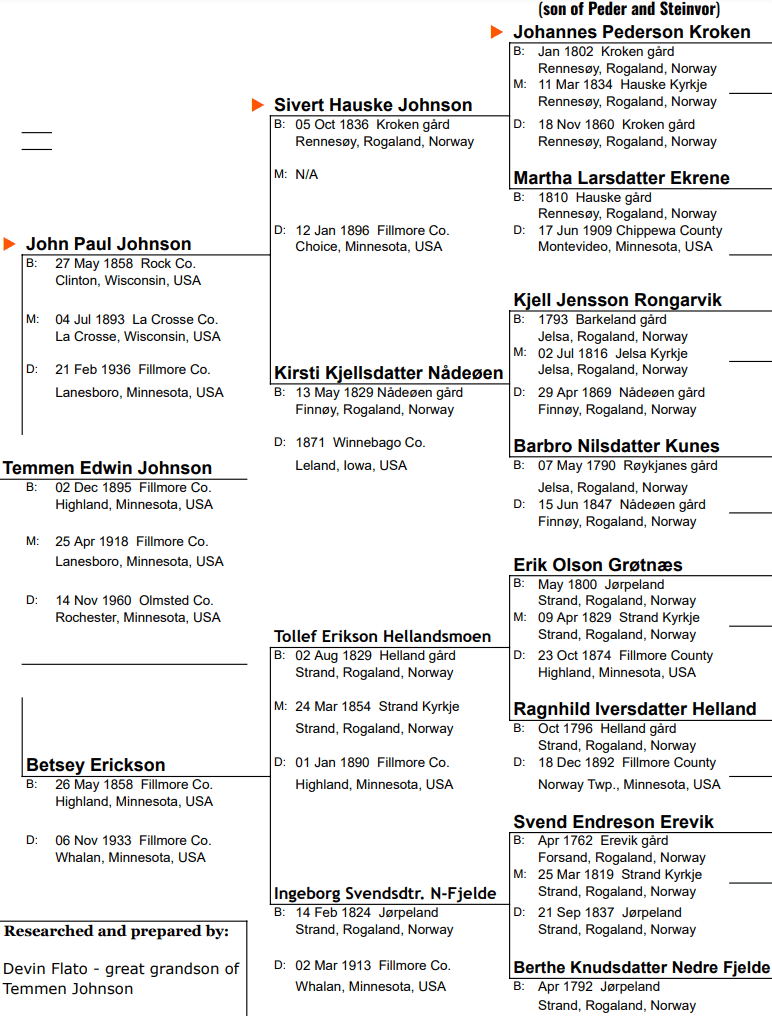
(Click-view all charts and images to enhance mobile version)
My objective for this Autosomal DNA study is to analyze and interpret the path of shared DNA segment inheritance from the earliest known common ancestor.

2018 visit to Western Norway
Introduction
The Norwegian Bygdebøker [farm books] are the primary source of family history and genealogy for researchers learning about ancestry in Norway.

Page from the Rennesøy Bygdebok – my 5th great grandfather [5] and 4th great grandfather [c]
The church and census records in Rogaland County date back to the 1600’s, while the court records date back much further. These genealogical records (including the bygdebøker) make it possible to trace Rogaland ancestry back to the 1600’s and earlier. Of the fifteen DNA matches in this study, thirteen of them share deep rooted ancestry in Rogaland.
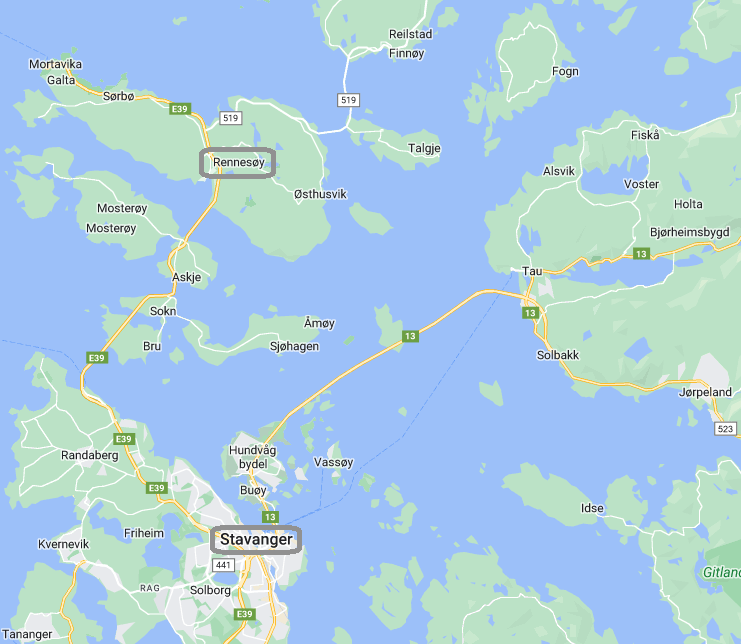
Rogaland County in Southwestern Norway
Shared Ancestry in the Triangulation Group
After a period of extensive research and collaboration with TG [Triangulation Group] matches, I found a total of three separate common ancestral couples from the 1600’s, shared within my Rogaland County match group. Only one of the mentioned couples; however, is the genetic placeholder in the Triangulation Group.
Calibrating the TG Alignment
The lineal pathway of a shared DNA segment, must coincide with the segmentary lineage within a Triangulation Group. Undertaking this genealogical task requires a process of elimination among multiple common ancestors, in order to balance and interpret the alignment of shared Genetic Ancestors.

The following ancestral charts include all of the TG matches, sorted and arranged in an incremental system of individual scales. A format that I refer to as Segmentary Lineage Scales.
Shared ancestral couple #1

Shared ancestral couple #2

Process of Elimination
While the charts above identify common ancestry with several of my TG matches, I did not find relation of additional TG matches within the ancestry of the mentioned couples. Of the three ancestral couples shared within my Rogaland County match group, only one remains as a placeholder in the Triangulation Group (see next chart).
Shared ancestral couple #3

Jon Austbø and his wife; Ingeborg, were the great grandparents of Steinvor Johannesdatter Reienasis (mentioned in connection with Triangulation Subgroup A). This observation links a subgroup consisting of my closest cousins, to an earlier MRCA [Most Recent Common Ancestor] match group consisting of remote cousins. Thus, forming a new triangulated subgroup.

Triangulation Subgroup B
Tipping the Scales
Concepts of geometry support the methods that led to the convergence of the new subgroup (B). The framework of this genetic alignment calibration, using line segment points, scales and patterns, led me on a refined path of new discoveries, as demonstrated in the following charts.
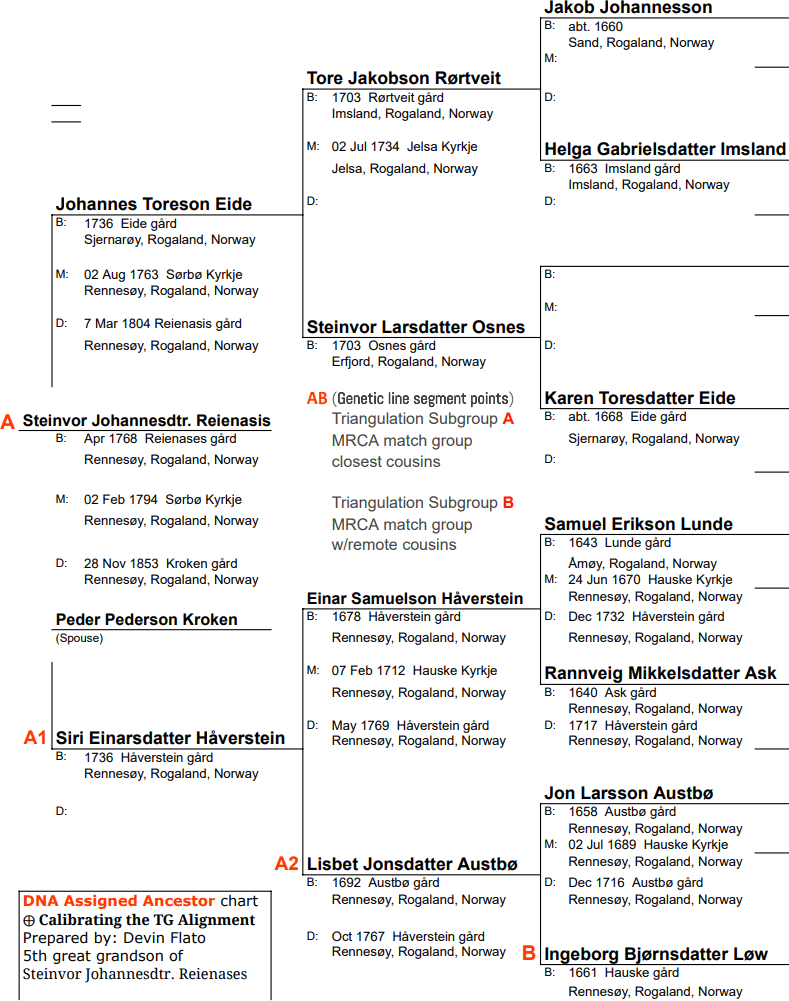
Ingeborg Bjørnsdatter Løw – MRCA of Triangulation Subgroup B, was the daughter of Bjørn Løw and Anna Wegner.


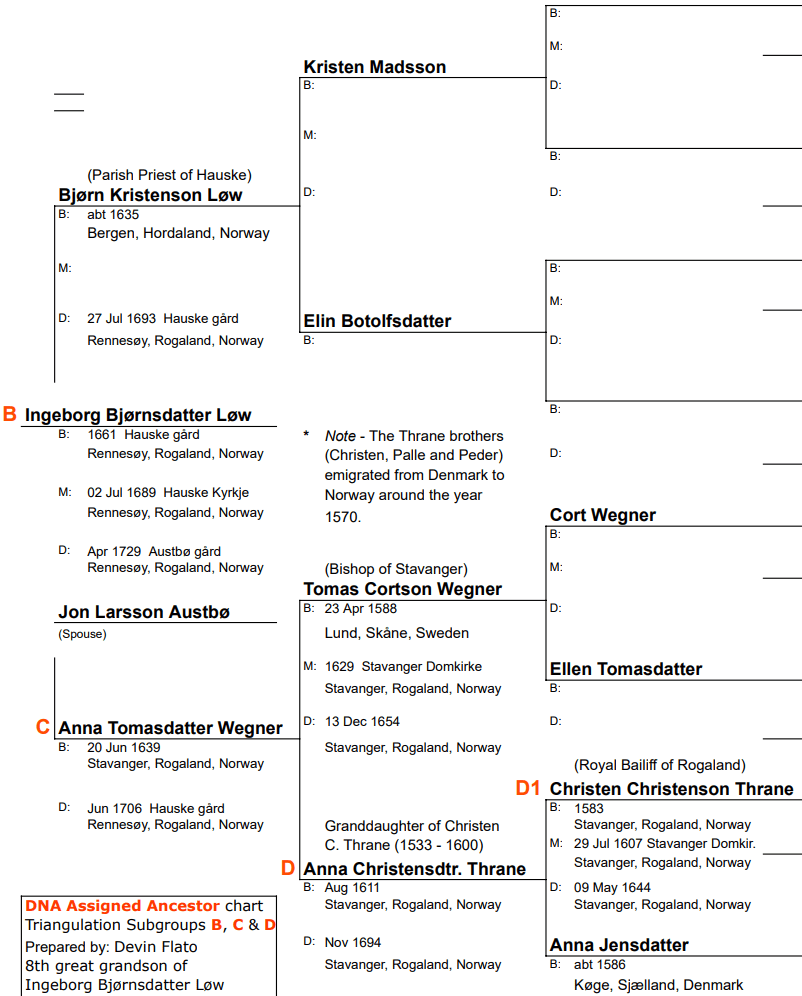
Triangulation Subgroup C
Anna Tomasdtr. Wegner – MRCA of Triangulation Subgroup C, was the daughter of Tomas Wegner and Anna Thrane.


Triangulation Subgroup D
The Power in Numbers
The majority of my TG matches (nine of fifteen) share common ancestry through Tomas Cortson Wegner and his wife, Anna Christensdatter Thrane. This cumulative pathway was revealed through the ascending order of triangulated subgroups. – A strategy that I developed, which coincides with the ascending alignment of my DNA Assigned Ancestors.

17th Century epitaph painting in Stavanger Domkirke – Norway’s oldest Cathedral. Anna Christensdatter Thrane [standing center] was my mother’s 9th great grandmother. Anna’s husband, Tomas Cortson Wegner (not present in the painting) was the Bishop of Stavanger until his death in 1654.
Anna Christensdtr. Thrane – MRCA of Triangulation Subgroup D, was the granddaughter of Christen Thrane & Karen Povelsdatter.


Triangulation Subgroup E
Pattern Recognition
While searching for DNA matches with the ancestral surname; Thrane at MyHeritage, I found Olsen and Bjørkeng, and to my surprise, they matched me on Chromosome 14. Olsen and Bjørkeng (from the unrelated column) are distant cousins to each other, with deep ancestral roots in Northern Norway. They do; however, share one distant ancestor from Southwestern Norway – Peder Christenson Thrane (1541 – 1622) from Stavanger. Coincidentally; Stangeland, Warland and Espedal (also from the unrelated column) descend from Peder’s brother; Palle Christenson Thrane (1537 – 1584). Peder was the half-brother of Palle and Christen Christenson Thrane (1533 – 1600) – my Direct Ancestor, and of all other matches within the Triangulation Group.


All fifteen of my DNA matches, sharing IBD (Identical By Descent) segments on Chromosome 14
My Conclusion
Christen Pederson Thrane, born circa 1500 in Denmark, and father of Christen, Palle and Peder Thrane (mentioned above), is the Apical Genetic Ancestor of the DNA segment that I inherited on Chromosome 14, including for all of my DNA matches mentioned in this project.
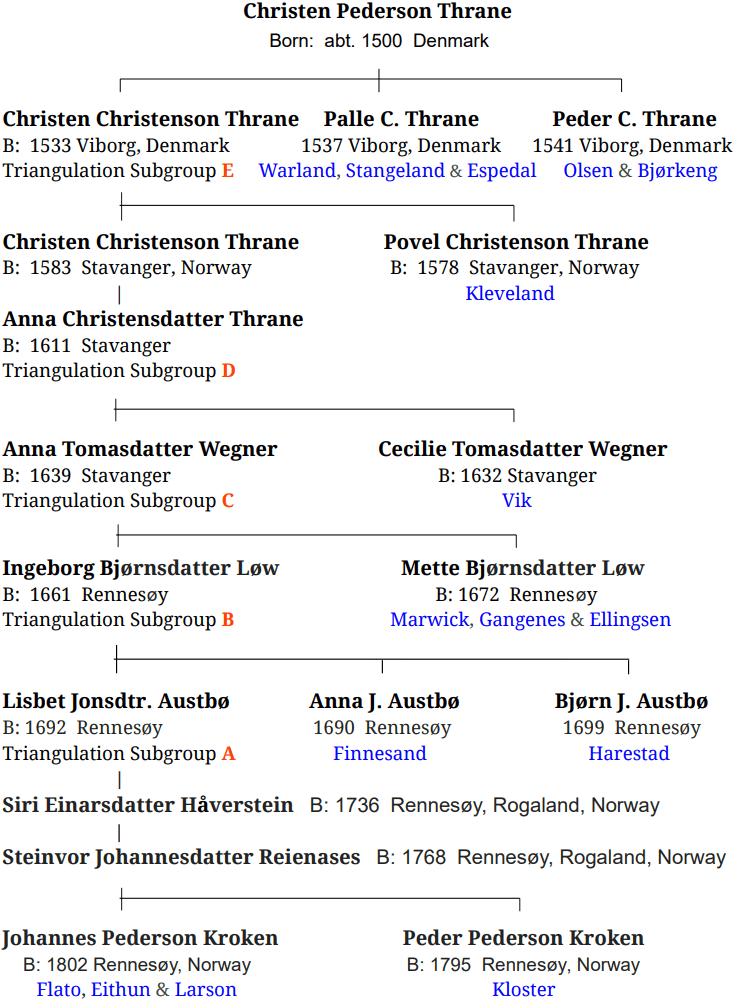
Segmentary lineage chart – ascending to the Apical Genetic Ancestor of the Triangulation Group
Confirmed Relationship of My DNA Matches
| (Last) Name | Shared segment cM’s | Genetic relation |
| Eithun | 15.9 | 3rd cousin, 1R |
| Larson | 8.3 | 5th cousin |
| Kloster | 22.7 | 6th cousin |
| Harestad | 19.6 | 9th cousin |
| Finnesand | 7.4 | 8th cousin, 1R |
| Marwick | 22.7 | 9th cousin |
| Gangenes | 7.7 | 7th cousin, 3R |
| Ellingsen | 11.0 | 9th cousin, 2R |
| Vik | 8.6 | 8th cousin, 3R |
| Kleveland | 10.4 | 13th cousin |
| Stangeland | 21.6 | 12th cousin, 2R |
| Warland | 17.8 | 13th cousin, 1R |
| Espedal | 12.9 | 14th cousin, 2R |
| Olsen | 15.3 | 14th cousin |
| Bjørkeng | 9.5 | 12th cousin, 2R |
- Supporting evidence in the form of DNA match trees are privately secured, for the record. DNA testing companies associated in this study: Family Tree DNA, MyHeritage, Ancestry, 23andMe and Gedmatch. Chromosome maps by DNA Painter.
Thrane Family Crest
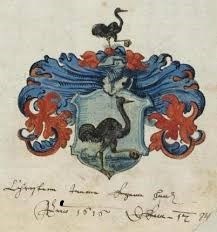
“The crane holds a stone (a symbol of vigilance). If the crane drops the stone, the stone splashes into the water – alarming the area”. Suggesting that the family is closely guarded.
Disclosure
A DNA discovery of this magnitude has substantial hurdles and therefore, I must address the complexities in my conclusion of this study.
- Coefficient of Relationship. Whether distant or remote, endogamy is intertwined in our ancestry. Even a random cousin marriage in recent or distant generations will undoubtedly complicate the outcome in Autosomal DNA research. However, as substantiated in this study, there is no evidence of pedigree collapse within the direct inheritance pathway of my DNA Assigned Ancestors. Consequently, this keeps the coefficient of relationship accurate and unaffected by inflated DNA sharing.
- Segment Phasing. While sorting through shared matches with my siblings and TG matches, I was able to identify my false positive matches on Chromosome 14, and exclude them from my research.
- Tree Completeness. Traditional genealogy is the weakest link in the practice of genetic genealogy. With that being said, I began to hit the occasional brick walls in my research of DNA ‘match trees’ at about eight generations. However, most of the branches in all of the Norse related trees traced back much further. In part, due to the broad relation and documentation of prestigious heritage throughout the Stavanger Region.
My conclusion in this DNA study was formed upon two (pandemic era) years of extensive research, including: Pedigree triangulation, segment data mapping, cross referencing records, collaboration with DNA matches, building mirror trees with integrity, and utilizing every genealogy tool to the best of my ability.
“Only those who attempt the absurd can achieve the impossible.”
Albert Einstein